Re-learning the Value of Money
What does money actually feel like anymore?
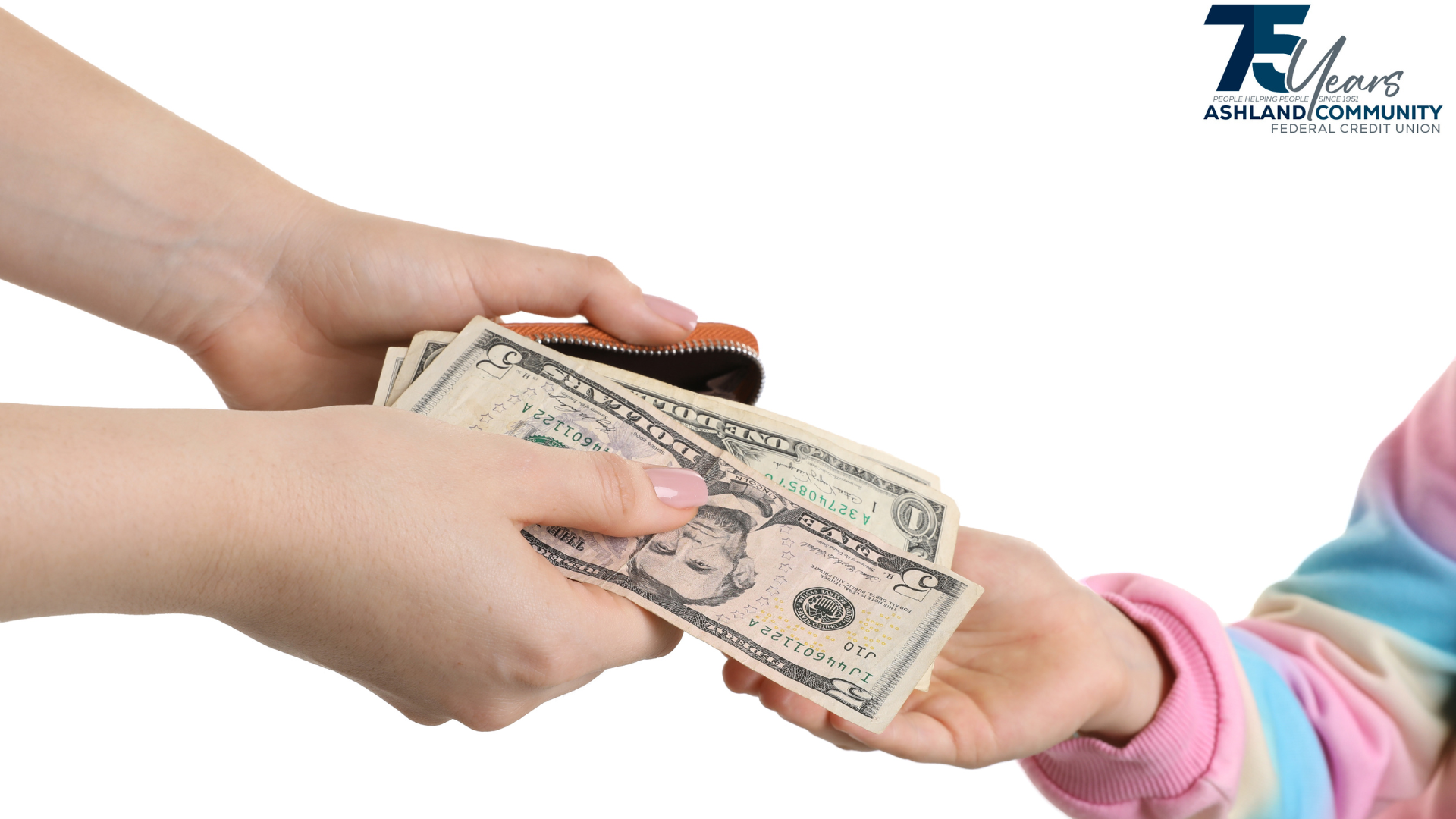
When is the last time you carried it around with you? Real, spendable bills, folded in a wallet. And with change back to put in your pocket. Not in a balance on a screen, but in real life, when almost everything we buy is one tap, one swipe, one click away.
April is Financial Literacy Month, and as Ashland Community Federal Credit Union celebrates 75 years of serving our community, it’s a good time to ask a question that’s easy to overlook:
Have we lost our sense of what things actually cost?
The Rise of “Invisible Spending”
Not that long ago, cash made up about 31% of in-person transactions. Today, it’s closer to 16–18%—and less than 10% of total spending value.
That’s a shift in behavior. When you hand someone cash, you feel it leave.
When you swipe a card…you don’t.
Behavioral research has consistently shown that people spend more when using cards instead of cash. It can be said that the “pain of paying” is reduced.
And when spending stops feeling real, it becomes easier to spend more, without ever thinking about it.
Is Tipping Still Optional?
Tipping used to be a reward or an incentive for good service. It was an option. And it was typically reserved for individual service. We tipped the waiter, or we tipped the taxi driver. Cash in hand for a job well done.
Now it shows up everywhere—and usually before you’ve even processed the total.
- Average tips with digital payments are now around 19–20%
- Even quick-service locations average about 15–16% tips
- Nearly 45% of people say they regularly tip 20% or more
And did you know:
- The average person spends about $150 per year on tips they didn’t feel were necessary
- That’s roughly $20–25 per month in “guilt tipping.”
There is nothing wrong with tipping. But if the decision is made for you, or feels obligatory, it becomes factored into the price. And we forget the value of the incentive.
It is not wrong to take a moment and evaluate whether the service is worth the tip, and if so, how much.
Convenience Is Quietly Costing More
We live in the most convenient time in history.
You can get almost anything ordered in seconds, delivered immediately, and paid for later
But convenience rarely comes free.
It shows up as delivery fees, service charges, credit card fees, higher interest payment plans and more.
One at a time, it doesn’t feel like such a big deal. A few pennies here, a couple of dollars there. But combined, we’re spending a lot more for things we used to get for a lot less.
The Disappearing Pause
There used to be a built-in moment before spending money.
We would count the cost, count the available cash, calculate if we had enough and decide if the value outweighed the expense. Then, we’d decide if we wanted to make the purchase now, or wait till later.
We don’t pause much anymore, do we? Things cost what they cost, and we swipe the card.
Or, we set up auto payments, auto-renews, auto-deduct. Today’s purchases can seem automatic and perhaps even out of our control. It’s just something we do. Default behavior.
Again, there is nothing wrong with using this convenience. But when we automatically make purchases without questioning the value, it has to be assumed that we will get less value, or purchase things we might otherwise not have done.
Teaching Value in a World Without Friction
If you feel like we’re being old school here, we’re not. We embrace the future, and we see the benefits. But we can also remember how things used to be. For younger generations, money isn’t something they have ever had to hold. It’s numbers on a screen.
That makes financial literacy more important, and more difficult, than ever.
It makes sense to help our younger consumers understand the value of money. A few practical ways to bring value back into focus:
- Make money visible
Even occasionally using cash helps create awareness of spending. Let them know that when it’s gone, it’s gone. - Talk through decisions
Why you chose something. Why you waited. Why you didn’t. They’ll say, “Just put it on the card”. That’s a great opportunity to explain how credit cards work. - Let them experience trade-offs
Spending on one thing means not spending on another. Explain budgets to them, why you have - Connect money to effort
Work, time, and earning should feel connected—not abstract.
Assuming you’re an adult, it makes sense to do these things, too. Because the truth is, we’re all adjusting to this new environment.
75 Years of “People Helping People”
For 75 years, Ashland Community Federal Credit Union has believed that financial well-being starts with understanding and making wise and well-thought-out decisions. You can count on us to help you with those, and to help you take action when you’re ready.
Financial Literacy Month is a reminder that money is a tool. We need to use it for the right reasons, in the right way, and for the right reasons.
And most importantly, we need to use it when it’s worth it.